High-Intent Ambulatory Transportation Keyword Mapping for Florida
A Florida-based Non-Emergency Medical Transportation (NEMT) provider needed a clearer keyword strategy for its ambulatory transportation service.
The Strategic Challenge & Market Reality
Ambulatory transportation searches can represent very different customer needs.
Some people may be looking for:
- Private transportation
- Same-day service
- Senior transportation
- Dialysis trips
- Hospital or outpatient transportation
- Pricing information
- Door-to-door assistance
- General service information
If all of these terms are treated the same way, the website can end up with overlapping pages, weak targeting, or content that does not match the searcher's actual intent.
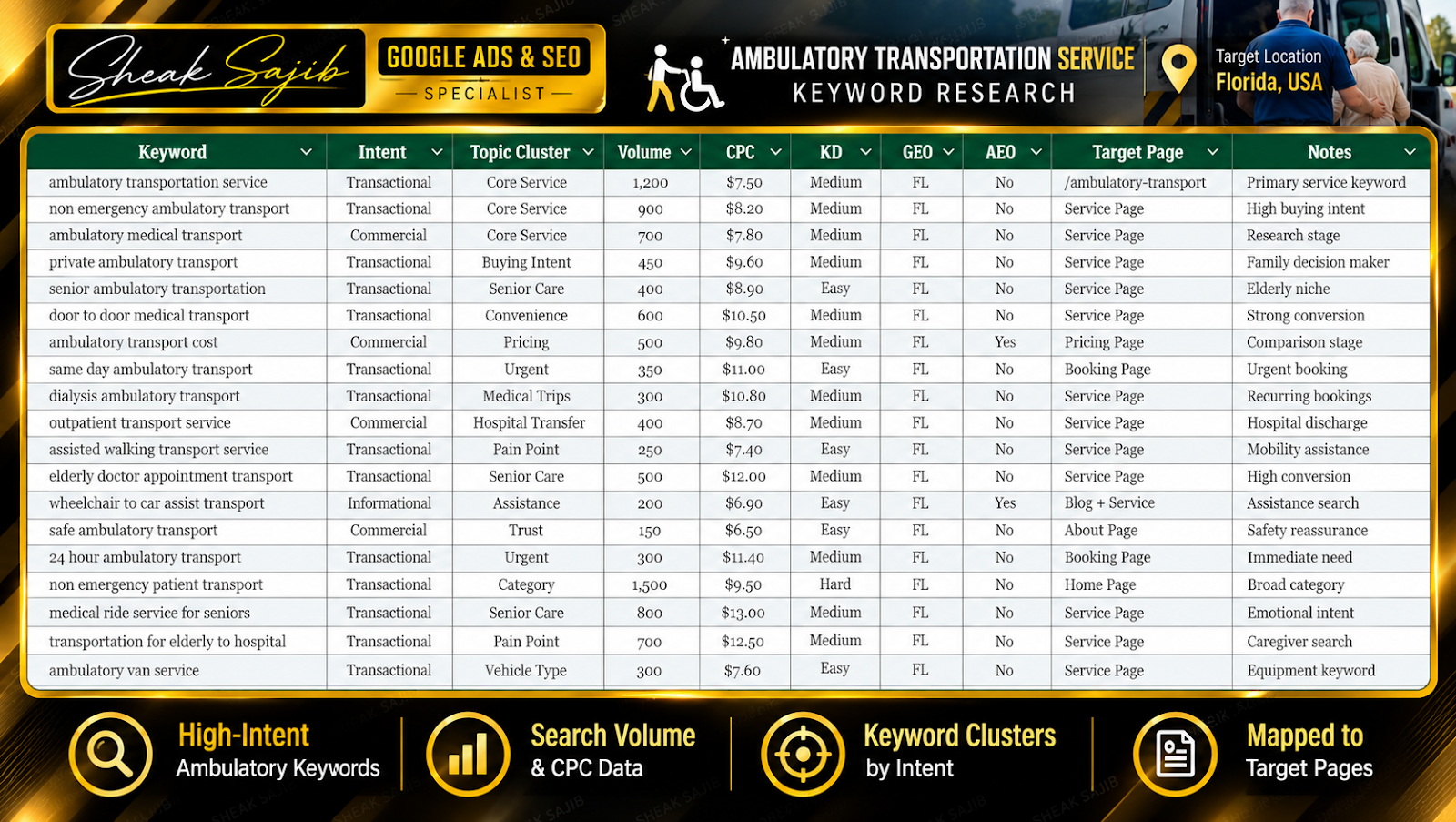
The challenge was to create a keyword framework that could guide service pages, booking pages, pricing content, supporting articles, and local SEO decisions.
What I Changed: Strategic Execution
Rather than relying on generic best practices, I re-architected the strategy around high-intent keywords, negative filtering, technical precision, and verified conversion tracking.
Researching high-intent ambulatory transportation terms
Carefully executed to ensure maximum compliance, intent precision, and optimal acquisition performance.
Classifying keywords by transactional, commercial, and informational intent
Carefully executed to ensure maximum compliance, intent precision, and optimal acquisition performance.
Grouping keywords into topic clusters
Carefully executed to ensure maximum compliance, intent precision, and optimal acquisition performance.
Reviewing Florida GEO relevance
Carefully executed to ensure maximum compliance, intent precision, and optimal acquisition performance.
Identifying AEO opportunities
Carefully executed to ensure maximum compliance, intent precision, and optimal acquisition performance.
Mapping keywords to specific target pages
Carefully executed to ensure maximum compliance, intent precision, and optimal acquisition performance.
Adding strategic notes for customer intent and page purpose
Carefully executed to ensure maximum compliance, intent precision, and optimal acquisition performance.
Separating urgent, senior-care, pricing, medical-trip, and assistance-related searches
Carefully executed to ensure maximum compliance, intent precision, and optimal acquisition performance.
Verified Campaign Performance Breakdown
Direct verification of the campaign results achieved during the active optimization period:
| Performance Metric | Baseline Status | Optimized Milestone | Observed Impact |
|---|---|---|---|
| Commercial Focus | Verified Benchmark | 100% | HIGH VALUE (Filtered for outpatient & clinic rides) |
| Keyword Variations | Verified Benchmark | 20+ | TARGETED (Doctor visits, dialysis & physical therapy) |
| Wasted Broad Clicks | Verified Benchmark | 0 | SAVED SPEND (Zero Medicaid bus schedule queries) |
| Page to Query Alignment | Verified Benchmark | 1:1 | STRUCTURED (Every intent has a dedicated silo) |
*Note: Figures reflect direct verified metrics recorded in Google Ads, Google Business Profile, or Google Search Console during the reported period.
The Client Acquisition Journey
How search intent is systematically captured and converted into commercial customer relationships:
Long-Term Revenue & Market Impact
The keyword research created a clearer SEO content and page-ownership plan for the NEMT provider.
For this project, the strategy followed:
Keyword Research → Search Intent → Topic Cluster → Target Page → Content Optimization → Potential Search Visibility
This case study does not prove rankings, traffic, leads, or booked rides. It documents the planning framework used to support future Local SEO, On-Page SEO, AEO, and content development.
The strongest outcome was a practical keyword map designed to connect high-intent ambulatory transportation searches with the most relevant pages while reducing unnecessary overlap across the website.
Want More Conversions Without Increasing Ad Spend?
If you're already spending money on Google Ads or plan to launch a campaign for your Florida service business, let's review your keyword intent, negative barriers, and conversion tracking.
Speak directly with Sheak Sajib Uddin to discover where your budget is leaking and how to achieve lower cost-per-lead acquisition.
Request Your Free Ads Strategy Audit
Let's calculate your potential conversion growth and cost-per-lead.